Mostrando entradas con la etiqueta Medio Ambiente. Mostrar todas las entradas

domingo, 18 de abril de 2010

Eyjafjallajökull (fotos)


Todas las fotos son de AP y Reuters.


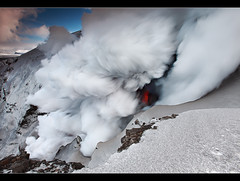
Con enorme violencia hizo erupción por segunda vez dentro de las últimas cuatro semanas el volcán que se pronuncia algo como Ey-fala-ja-cul. El magma salió impulsado a través del hielo de varios metros de grueso. La columna de humo mide unos 11 kilómetros.
Se dice que hace 200 años hizo erupción el Eyjafjallajökull y el humo duró varios meses.
Se dice que antigüamente se pensaba que en Islandia estaba la puerta al infierno por sus enormes contrastes entre lo blanco del hielo y lo negro del humo de sus volcanes, lo frío y lo caliente. Detrás de la cortina de humo salía el sol y daba la impresión de un infierno...
Se han cancelado más de 17 mil vuelos en Europa.
Hasta ayer estaban cerrados la gran mayoría de aeropuertos en Alemania. Hoy se cerró Barcelona.
El costo diario para las líneas aéreas es de unos 150 mdd diarios.
En Alemania no se puede ver o percibir la nube -al menos a simple vista-. No así en Londres, donde además se ha advertido a personas con asma y problemas respiratorios que tomen precauciones.


viernes, 16 de abril de 2010

El volcán Eyjafjallajökull

Pues amanecimos grises...
Volcanic Ash to Curtail Air Traffic Into Midday Friday

By NICOLA CLARK and LIZ ROBBINS
The plume of ash from a volcano in Iceland forced aviation authorities to order the restrictions, affecting thousands of flights in a wide arc from Ireland to Scandinavia

sábado, 27 de marzo de 2010

Blackout en el Confesionario (again)

Seguro que gracias a una hora sin luz, hoy el mundo es mejor...

Apagar la luz entre las 20.30 y las 21.30 tiene el mismo efecto que la confesión católica: purificar la conciencia para volver a pecar con placer, y mientras apagamos nuestras luces durante una hora, las bolsas de plástico siguen allí tiradas, las colillas flotando en el lago, los animales siguen en peligro de extinción, los polos derritiéndose, la tierra calentándose, las fábricas y los autos contaminando,...
Cuántos aparatos eléctricos tienes conectados a la corriente eléctrica en tu casa? Cuando sales de vacaciones, los desconectas?
Usas focos de pocos watts? Prendes la luz sólo cuando es necesario? Desconectas los aparatos eléctricos cuando no los necesitas? Usas bolsas de tela o canastas cuando vas al super? Rechazas las bolsas de plástico cuando vas de compras? Qué haces con las bolsas? reciclas? reusas?

Digo, sólo por mencionar algunas tareas que auydan mucho más que la limpieza de conciencias una vez al año.


Y tú, te confesarás hoy en lanoche? Cuántos aves maría te tocará rezar durante el blackout?


domingo, 20 de diciembre de 2009

Gran Booo a los líderes mundiales #cop15


EDITORIAL
La cumbre parió un ratón
El acuerdo de mínimos de Copenhague ni siquiera fija objetivos de reducción de emisiones
20/12/2009
La cumbre de Copenhague sobre el Cambio Climático terminó ayer con un resultado decepcionante, sobre todo a la vista de las expectativas abiertas por el principio de acuerdo previo entre Estados Unidos y China sobre las emisiones de gases de efecto invernadero que incluía una reducción efectiva -aunque insuficiente- por parte del primero, y una reducción ligada al crecimiento del PIB de la potencia asiática.

Pero ni siquiera se ha llegado a esto. El acuerdo final, cocinado por los líderes de unos pocos países y aceptado por el resto, con la oposición de cinco de ellos, sólo reconoce la necesidad de contener el aumento de la temperatura media del planeta en dos grados, un umbral por encima del cual los efectos podrían ser irreversibles, y que en algún momento se ha de llegar a un máximo en la cantidad global de gases emitidos. Un acuerdo con un grado de concreción menor que el del Protocolo de Kioto, a pesar de que la situación es ahora mucho más preocupante que hace una década.

Los líderes mundiales eran conscientes de que no bastaba con un compromiso concreto de reducción de las emisiones si no iba acompañado de una definición sobre los procedimientos para alcanzarlo, que implican necesariamente cambios profundos en nuestros hábitos de consumo energético y afectan a la vida ciudadana, a los usos domésticos, a la movilidad y la actividad industrial. Pero en Copenhague ni siquiera se ha logrado lo primero. El nivel total de emisiones no ha dejado de aumentar desde que se celebró la Cumbre de la Tierra de Río, en 1992, donde se sentaron las bases de los acuerdos que vendrían después. Y no parece, a la vista de la escasa voluntad mostrada por los países que más emiten, que esa tendencia vaya a cambiar en los próximos años. Malas noticias sin paliativos, para el planeta y para el conjunto de sus habitantes.

Todos tienen una parte de responsabilidad en este fracaso, pero no hay duda de que la mayor debe asignarse a Estados Unidos, que es, con diferencia, el primer país en emisiones per cápita, y a la par que China, con más de cuatro veces su población en emisiones globales, que no aceptó compartir esfuerzos con los demás países desarrollados en el Protocolo de Kioto, y que ha seguido incrementando sus emisiones poniendo su interés económico a corto plazo por delante de cualquier otra consideración.

Por supuesto que otros países también pueden entorpecer el progreso en este campo, pero una actitud decidida de los estadounidenses cambiaría radicalmente el panorama. Ahora seguimos esperando que el Senado y el Congreso de dicho país tengan a bien debatir y aprobar una ley sobre emisiones de CO2 para poder concretar una política global que mitigue los efectos de la dinámica de cambio climático en la que estamos envueltos. Esperemos que esto ocurra pronto y los líderes mundiales puedan volver a reunirse el año que viene y rubricar el acuerdo firme y eficaz que el planeta necesita.

© EDICIONES EL PAÍS

Failure in Copenhagen
Gunning Full Throttle into the Greenhouse

An Editorial by Markus Becker in Copenhagen

What a disaster. The climate summit in Copenhagen has failed because of the hardball politicking of the United States, China and several other countries -- and because people just can't seem to fathom how catastrophic climate change will be. They probably won't have long to wait before things become a bit clearer.

The global climate summit in Copenhagen has failed. There will be no concrete goals for reducing greenhouse gas emissions. Industrialized countries extended no concrete offers of hope to developing countries. Newly industrializing countries, such as India and China, can continue to grow their economies without any checks and balances for the climate.

In the run-up to the conference, scientists, environmentalists and politicians alike called it one of the most important in history. But now it's just a missed opportunity. Likewise, it might just be one of the last of its kind in the battle against climate change.

It took governments from around the world 17 years to come together for this summit in Copenhagen -- 17 years of talking, seemingly endless negotiations, ideological debates, delays and maneuvering. It's been 17 years since the first climate-related meeting, held in Rio in 1992. It's been 17 years of searching for solutions to confront the threats resulting from climate change. And this is what we're left with. Many of the hopes that had been building up since 1992 have now been shattered.

Right up until shortly before the end, it looked like they might have been able to prevent Copenhagen from failing. The last drafts of the final declaration included provisions not only for limiting the rise of global temperatures to 2 degrees Celsius above preindustrial levels by 2050, but also for how this could be achieved. There was mention of reducing greenhouse gas emissions by 80 percent by 2050 and even the possibility of a mid-term goal by 2020.

Obama's Only Concession

In the end, the mini draft accord that about 30 leading countries agreed upon Friday evening only included the provision on the 2-degree mark -- without any concrete plans for the decades to come. Still, they only made non-binding commitments when it came to the limits that scientists have set as thresholds for preventing a climate catastrophe. Moreover, given the fiasco in Copenhagen, this 2-degree limit might no longer be kept.

No wonder so many of the other of the 192 total countries almost immediately tore to shreds the compromise plan that the group of 30 countries presented in the main hall. Those countries that could face destruction as a result of climate change, in particular, could not see any solutions in it.

Now we are faced with the threat of an impasse in global climate politics. And the consequences of this holdup will primarily be felt by the poorest of the poor.

Experts anticipate that they will be subjected to storms and flooding stronger than ever before. Their crops will wither. Melting glaciers might deprive several million people of their water supplies and deprive them of their livelihoods.

Nor will the industrialized states be spared from its consequences. But, thanks to their technical and financial resources, they will be in a better position to cope with them.

The debacle of Copenhagen is also Barack Obama's debacle. The US president made only one concession at the summit meeting: He pledged to join those providing financial assistance to poor countries. These funds are meant to allow such countries to be in a better position to combat the consequences of climate change and to pursue economic growth in a more eco-friendly way, just like the more established industrialized states have done. Beginning in 2020, these funds should amount to an annual $100 billion (€70 billion) -- which US Secretary of State Hillary Clinton boasted in Copenhagen was "a lot of money." But when it came to the issue of how much of this money would come from the United States, she didn't say a thing. And even the mini draft agreement of the "Copenhagen Accord" hammered out by the world's leading nations doesn't throw any light on this matter.

'Not Enough'

The accord also holds another detail on just how generous the United States is. When it comes to immediate assistance for impoverished countries, the United States intends to contribute a total of $3.6 billion between 2010 and 2012. But, if you compare that with what other regions contribute, this figure appears rather miserly. The European Union plans to contribute about $10.6 billion, or about three times as much. And even Japan is chipping in $11 billion.

In poor countries, people are presumably confused about whether they should laugh or cry about the US contribution.

For the last 17 years, the United States has been one of the main countries putting the brakes on climate protection. But in the end, of all countries, it is the one that is criticizing the compromise plan it negotiated with the group of 30 countries as not going far enough. "It's not enough to combat the threat of climate change," said one negotiator -- as if US policies as a whole were ever really interested in that. And Obama -- who is supposedly all about fresh starts -- has done nothing to dispel doubt about the earnestness of US climate policies.

The major newly industrialized countries -- and, especially, China -- hardly behaved any better. China is also much more concerned about short-term economic interests than the long-term well-being of humanity. With its refusal to subject its climate-protection measures to international controls, China might have played a decisive role in causing the summit to fail.

Copenhagen's collapse merely confirms the opinion of those who view climate change as some pipe dream of scientists, left-wing politicians and the panic-fomenting media. And it also confirms the position of all those who believe that humanity is simply incapable of finding a solution for a threat like climate change through multi-lateral, collective efforts.

A Failure of Imagination

Incidentally, this stance is in no way just pure cynicism. Instead, it is based on a certain insight into human nature. People act from their own personal experiences and circumstances. For example, many have a hard time imagining that an epidemic can depopulate whole swaths of land -- despite the fact that this very thing has already happened a number of times. The same holds true for volcanic eruptions or meteorite impacts, which have turned entire regions and even continents into deserts. But, in this regard, climate change is even more dangerous because, for the most part, it is completely unprecedented:

No war or epidemic has ever impacted more than a handful of countries at the same time, not even the danger of nuclear war. But climate change affects practically all humans everywhere.
It must be combated quickly despite the fact that its gravest consequences lie in the future and do not constitute immediate threats.
Combating climate change demands revolutionary changes in how a major proportion of humanity lives its life.
It demands that societies, whose interests could not be more different, work together. Consider, for example, the differences between oil-producing states, which live from the proceeds of fossils fuels, and island nations, which could be completely destroyed by the effects of climate change.
It runs counter to the human psyche to comprehend such a danger -- let alone to combat it with determination and sacrifice. Unfortunately, all too often, people prioritize short-term success over long-term planning.

You can clearly see this stance in action in common, everyday things. You can tell people till your voice gives out that, in the long run, an energy-efficient compact flourescent light bulb saves them money; but when you see them in the supermarket, they are much more likely to reach for the 99-cent incandescent light bulb than the more expensive energy-efficient one sitting right next to it on the shelf. What's more, in the end, that person still believes he or she has gotten a bargain. Entire library shelves are full of academic studies pointing to similar results.

Likewise, as Copenhagen proved, when it comes to climate change, you also have to deal with the fact that the world doesn't have a political instrument for approaching this problem in an effective way. So many heads of state and government came together in Copenhagen, under considerable external pressure, to unify the world and reach a decision based on shared interests. Who knows if they will ever do so again?

Still, it wasn't enough. There will be those that say that -- given man's shortcomings -- it could never be enough and never will be enough.

They might just be right.


URL:
http://www.spiegel.de/international/world/0,1518,668111,00.html

martes, 8 de diciembre de 2009

Copenhagen: Day 1&2

Day 2 of the United Nations climate talks in Copehagen is underway. The UK continues to push for a global agreement that's ambitious, effective and fair. Thanks for backing the bid and helping us secure the 2 degree deal.
Yesterday, Gordon Brown urged the world to see the transition to low carbon as an opportunity, adding 'our children won't forgive us if we fail'. In a press conference with Danish Foreign Minister, Per Stig Møller in Brussels, Foreign Secretary David Miliband reitterated the EU's commitment to shift to an a 30% reduction in emissions if an ambitious global deal could be reached at Copenhagen.
Keep up with events throughout the day at www.actoncopenhagen.gov.uk.

On day 2 at COP 15:

US announcement
The US Government has declared carbon dioxide a ‘toxic’ gas that endangers public health in a judgement that gives the Obama administration a legal basis for capping harmful emissions.
The ruling will allow the agency to regulate planet-warming gases even without legislation in Congress. Under existing laws the agency could begin to make rules as soon as next year to regulate emissions from vehicle exhausts, power utilities and heavy industry.

Ed's Copenhagen send-off
Ed Miliband is taking part in a public meeting today in Manchester, jointly organised with Manchester Friends of the Earth. This will be Ed’s last public event before he travels to Copenhagen.
Coinciding with the launch of Manchester’s climate change action plan, the event will include speakers such as The Guardian’s John Harris and Friends of the Earth’s Campaigns director Mike Childs.
Yesterday
The much anticipated United Nations Climate Change negotiations began yesterday in the Danish capital of Copenhagen. It's crunch time as 192 countries convene to agree a global deal on climate change. The Bella Centre was a hive of activity as the formal sessions began yesterday morning, with an opening plenary at 10am. Outside the negotiations hall, demonstrators and NGOs gathered to press the urgency of a global deal.
7 December - South African targets for reducing growth in carbon emissions
South Africa has become the latest emerging economy to set out targets for reducing growth in its carbon emissions. President Jacob Zuma said that South Africa will take action to reduce current emissions by around 34% by 2020 and around 42% by 2025. In a statement on the presidency's website, the government said that this offer would enable South Africa's emissions to peak between 2020 and 2025, plateau for approximately a decade and decline in absolute terms thereafter.
7 December - Foreign Ministers from around the world call for global action at Copenhagen
The EU Council meetings held in Brussels coincided with the first day of the Copenhagen Climate Change Conference and David Miliband took part in a climate change focused press conference with Danish Foreign Minister Per Stig Møller. The EU7 Foreign Ministers have engaged personally to ensure that climate change and the challenges it poses is a matter of the highest priority on the international agenda, and are committed to the common goal that the global community honours its responsibility to support those countries which will be hardest hit by the effects of a changing climate.
Just before the start of the UN Conference on Climate Change in Copenhagen, the Foreign Ministers of Cape Verde, Costa Rica, Iceland, Singapore, Slovenia, and the United Arab Emirates have agreed to strengthen their commitments and call for renewed global action to address climate change.
7 December - World only a 'few billion tonnes' short of climate target
The offers that countries have already made to reduce their carbon emissions are only a 'few billion tonnes' short of the total cuts needed to hit the target of capping the rise in global temperatures, Lord Stern said in Copenhagen as the climate change conference got underway.
Lord Stern, the economist and climate change expert, wrote an analysis of national proposals for annual emissions reductions for the United National Environment Programme (UNEP).
The research estimates that in order to have a 50/50 chance of avoiding a rise in global temperature of more than 2˚C – the level scientists believe will trigger environmental catastrophe - annual emissions of greenhouse gases must be no more than 44 billion tonnes by 2020.

lunes, 7 de diciembre de 2009

Qué quieren en #Cop15

Who Wants What in Copenhagen
Wall Street Journal

This week, officials from 192 countries will meet in Copenhagen to tackle global climate change, seeking a successor to the 1997 Kyoto Protocol.

Even if they can't negotiate a binding agreement, many countries hope at least to work out commitments to reduce their greenhouse-gas emissions and provide assistance to poorer countries likely to be hardest hit by the effects of global warming.

Each country, of course, has its own particular priorites and concerns, which is why an agreement is so difficult to reach. Here's a look at some of their agendas for Copenhagen.

U.S.
The U.S.'s failure to pass climate-change legislation has meant a delay in a deal at Copenhagen. But pending bills in Congress and the Obama administration's authority to regulate emissions give the country credibility—and negotiating leverage toward an eventual agreement. The U.S. may still pledge to cut emissions about 17% by 2020, while offering funding of low-carbon initiatives for poorer countries to draw them to an agreement. The U.S. also wants other countries, mainly China and India, to commit on when their greenhouse-gas emissions will peak, and will demand stringent standards for reporting, monitoring and verification of emissions and reductions.

China
China has pledged to curb carbon emissions as a percentage of gross domestic product by 40% to 45% by 2020. These would be voluntary cuts and therefore unlikely to be part of a binding climate-change pact. But it signals China's interest in an agreement at Copenhagen. Such a deal could bring the country benefits: more funding and technology transfers from developed nations, and as an exporter of solar-power and wind-power equipment, increased demand for its products. What China dreads most is the end of Kyoto provisions that grant tradable credits for reducing emissions; China has been the top receiver for the credits, getting 59% of the total.

India
India, which has long resisted the imposition of carbon-emission caps, says it is ready to cut emissions intensity 20% to 25% by 2020, but won't accept legally binding targets. It argues that it needs development and economic growth before it should consider fixed emission caps and that the developed world has a historic responsibility to take more restrictive measures because it caused decades of atmospheric damage. India also favors financing and technology transfer to boost green energy solutions.

Russia
Climate change isn't high on Russia's agenda; its attention is on the massive investments it needs to make its aging Soviet-era industrial infrastructure more energy-efficient—with a goal of a 40% improvement in energy efficiency by 2020. Diplomats say the country is willing to reduce emissions between 20% and 25% from 1990 levels. Prime Minister Vladimir Putin says Russia will join a post-Kyoto agreement only if other countries sign up for it and if Russian forests' contribution to reducing global carbon dioxide is taken into account.

Brazil
Brazil's government will aim to cut greenhouse-gas emissions between 36% and 39% by reducing deforestation in the Amazon rain forest and increasing the use of fuel-efficient cars and trucks that use biofuels as well as gasoline. But the emissions target is voluntary and depends on the government obtaining financing for the aggressive goals, indicating that Brazil isn't willing to stifle industrial output in Latin America's largest economy. And efforts to reduce deforestation in the Amazon could be stymied by lawlessness in the poverty-stricken region.

European Union
The 27-member European Union aims to speak with one voice in Copenhagen. Its goal: taking action that would limit global warming to two degrees Celsius (3.6 degrees Fahrenheit). The EU intends to cut CO2 emissions 20% by 2020 from 1990 levels and is willing to raise that target to 30% if other countries commit to do their part. It is also ready to help developing countries financially, but it hasn't committed to specific figures. Some Western European countries advocate generosity, but some newer members from Eastern Europe are much less willing to pay.

Poland
Poland and other Eastern European nations want a deal that isn't too economically burdensome. The issue is how financial support for developing countries should be shared by EU members. Wealthy members propose making contributions proportional to a country's emissions. But because Eastern members' energy sectors rely heavily on coal, they would pay disproportionately more than if shares were based on their economic output. Poland also wants to be able to continue selling certain carbon credits after the Kyoto protocol expires in 2012. Because Poland has reduced CO2 emissions by 30% over the past 20 years, it can sell credits worth billions of euros.

Africa
African countries blame developed countries for greenhouse-gas emissions and want to be compensated for the impact of global warming. But they disagree on priorities. The African Union wants billions of dollars (leaders won't say exactly how much) to adapt to climate change, which is blamed for record droughts in East Africa and flooding in other regions. Oil-producing nations, such as Nigeria, want compensation for the lost revenues that could result from expected declines in oil consumption by industrialized nations.

Indonesia
In Indonesia, the world's No. 3 carbon-dioxide emitter (after China and the U.S.), much of the emissions result from deforestation. It probably will ask for international technology and funds for forest conservation. Also, it favors self-monitoring in future programs that give credits for reducing emissions from deforestation, and hints it will oppose efforts to create an international monitoring body. The nation pledges to cut emissions 26% by 2020 from "business-as-usual" levels, but officials say Indonesia will raise its target to 41% if it receives the international funding and technology support it needs.

Ecuador
Ecuador, an oil producer, will come to Copenhagen with a novel idea: get rich countries to pay $3.5 billion to keep 850 million barrels of its crude in the ground. The oil is located in a natural reserve of the Amazonian forest whose protection will be a cornerstone of the talks. A delegation of the Organization of Petroleum Exporting Countries (Ecuador gets the group's presidency next year) has visited to look at the project. The government, which has renamed its oil ministry the "ministry of non-renewable resources," has pitched the idea to some European governments.

--Compiled by Ian Talley, Jing Yang, Paul Beckett, Alexander Kolyandr, Jeff Fick, Alessandro Torello, Marek Strzelecki, Benoit Faucon and Max Lin. They can be reached at reports@wsj.com.

Lo Básico en #Cop15

The essentials in Copenhagen

Rather than getting every small detail of a new global climate treaty done in Copenhagen, UN climate chief Yvo de Boer hopes the conference will reach agreements on four political essentials.

The UN climate conference in Copenhagen in December this year may not yield a new global climate treaty with every minor detail in place. But hopefully it will close with agreements on four political essentials, thereby creating a clarity the world – not least the financially struck business world – needs.

The wish for clarity is expressed by Yvo de Boer, executive secretary of the United Nations Framework Convention on Climate Change (UNFCCC), in an interview with Environment & Energy Publishing (E&E). According to Yvo de Boer, the four essentials calling for an international agreement in Copenhagen are:

1. How much are the industrialized countries willing to reduce their emissions of greenhouse gases?

2. How much are major developing countries such as China and India willing to do to limit the growth of their emissions?

3. How is the help needed by developing countries to engage in reducing their emissions and adapting to the impacts of climate change going to be financed?

4. How is that money going to be managed?

“If Copenhagen can deliver on those four points I’d be happy,” says Yvo de Boer.

He sees a need to get something signed and agreed in Copenhagen, but he thinks it will be very difficult to get every final, small detail of a whole new treaty done. The new climate treaty will be replacing the Kyoto Protocol which was adopted in Kyoto, Japan, in December 1997 and entered into force on 16 February 2005.

The Kyoto Protocol which sets binding targets for the reduction of greenhouse gas emissions has been signed and ratified by 184 parties of the UN Climate Convention. One notable exception is the United States, and Yvo de Boer is “really happy” to see the US back in the international climate change process and that the US is also engaging domestically in the process.

“My big lesson from the Kyoto era is that it's really important that the government delegation that represents the United States is in close touch with the Senate, with the elected officials on what's acceptable and what's not,” says de Boer, and he adds:

“I think that a major shortcoming of Kyoto was that the official delegation came back with a treaty they knew was never going to make it through the Senate. And this time I have the feeling that the communication is much stronger, that the Senate Foreign Relations Committee, through John Kerry, is really expressing strongly what they feel needs to be done in Copenhagen.”

Yvo de Boer thinks the Kyoto Protocol was rejected by the US for mainly two reasons. Firstly, because it did not involve action on the part of major developing countries. Secondly, because it was felt by the Bush administration that Kyoto would be harmful to the US economy.

Copenhagen will be a whole different scenario, and de Boer feels confident that President Barack Obama can successfully engage China and India and convince them to sign the next treaty.

“I think that Secretary of State Clinton's visit to Beijing was a really important and encouraging step to get us moving on that road,” says Yvo de Boer.

Asked about the global recession, de Boer thinks it will certainly have an impact on the negotiations in Copenhagen.

“You see already that investments in renewable energy projects are going down, partly because of the oil price going down and partly because of the economic activity going down,” he says.

But even though greenhouse gas emissions are expected to slow down as a result of shrinking industrial activities, de Boer does not believe it will lessen the pressure on countries to act and sign a new treaty.

“I get the impression talking to business people that they still want clarity from Copenhagen. If you're making investments now, for example in the energy sector, in power plants that are going to be around for the next 30 to 50 years, you can't really afford to keep waiting and waiting and waiting for governments to say where they're going to go on this issue.”

sábado, 11 de abril de 2009

Grønland: Osos o Brocolis?


Groenlandia (Grønland en danés; Kalaallit Nunaat en groenlandés), es un territorio autónomo perteneciente
al Reino de Dinamarca. Comprende principalmente la isla del mismo nombre, ubicada entre el Océano Atlántico y el Océano Glacial Ártico, y perteneciente al continente americano. Más del 84% de su superficie está cubierta de hielo, y es conocida como la mayor isla del mundo, si exceptuamos la isla-continente de Australia. El Primer Ministro actual es Hans Enoksen.

Este oso polar es el escudo nacional de Groenlandia.


Gracias al Cambio Climático, al calentamiento global, ahora Groenlandia puede volverse un jardín de flores y vegetales!!

En 1893 un botánico holandés plantó 4 pinos que ahora están reverdeciendo. Estos 4 pinos, llamados Rosenvinge´s trees en honor al botánico, son los árboles más antiguos de Groenlandia y ahora están verdes.

Poner atención en la utilización de las palabras "reverdecer" y "Groenlandia" en la misma oración!


A pesar de ser mucho más grande que Francia (4 veces aprox.), Groenlandia tiene solamente 9 bosques de coníferas, todos ellos cultivados. Tiene solamente 51 granjas, todas de ovejas. Hasta ahora, el único vegetal que se podía cultivar era la papa. La mayoría de los vegetales que comen los habitantes de ésta isla de hielo, vienen desde Dinamarca.

Parece que la importación de vegetales va a ser cosa del pasado, pues no solamente aquellos 4 viejos árboles están reverdeciendo, sino que ahora están cultivando por primera vez y con éxito: brócoli, coliflor y col. Los granjeros están experimentando con otros vegetales y los mismos agricultores no ven por qué Groenlandia no pudiera eventualmente estar repleta de granjas de vegetales y bosques...

Es esto una buena noticia? yo no creo. Prefiero que los groenlandeses sigan importando sus coles.

Sino, al rato en lugar de oso polar, el escudo nacional va a ser un Brócoli.


Slideshow con imágenes de Groenlandia del NYT aquí:
http://www.nytimes.com/slideshow/2007/10/27/world/1028-GREENLAND_index.html


domingo, 29 de marzo de 2009

Blackout en el confesionario

Seguro que gracias a una hora sin luz, hoy el mundo es mejor...

Apagar la luz entre las 20.30 y las 21.30 tiene el mismo efecto que la confesión católica: purificar la conciencia para volver a pecar con placer, y mientras apagamos nuestras luces durante una hora, las bolsas de plástico siguen allí tiradas, las colillas flotando en el lago, los animales siguen en peligro de extinción, los polos derritiéndose, la tierra calentándose, las fábricas y los autos contaminando,...

Y tú, te confesaste anoche? Cuántos aves maría te tocó rezar durante el blackout?


Related Posts with Thumbnails